Everyday Tasks
Meeting notes often mix decisions, suggestions and unfinished discussion. Use a structured extraction pass before turning them into a task list.
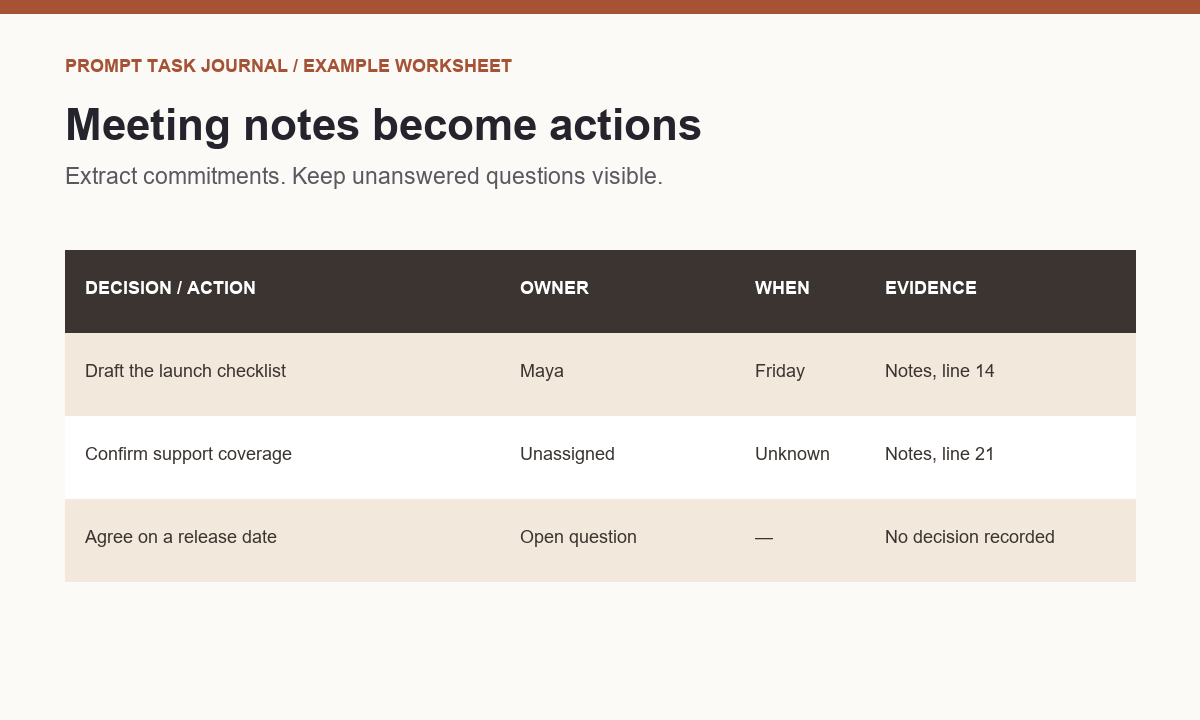
Keep extraction separate from interpretation
Start with notes that participants are permitted to share with the chosen service. Replace unnecessary personal details and label the meeting date. Ask for a faithful extraction first, not a polished recap. A suggestion such as “perhaps ask sales next week” should not emerge as a confirmed assignment.
Use evidence as a column
Give each note or paragraph a stable number. Request an evidence reference for every action. The reference is a checking aid, not proof that the extraction is correct. If the model combines two unrelated statements into a commitment, the reviewer should be able to see the mismatch quickly.
Resolve relative dates explicitly
“Next Friday” can be ambiguous when notes are copied later. Preserve the original wording and request a separate proposed interpretation, if needed. Confirm it with the meeting owner before entering a calendar date. Where the meeting date is unknown, leave the deadline unresolved rather than choosing the next Friday on the current calendar.
Publish a reviewed list
Separate confirmed actions from questions awaiting a decision. Ask the owner of the meeting to resolve the latter. Once a person approves the action table, it can become the source for a follow-up email. Keep the original notes available so later edits do not erase the reasoning behind the task. This is a proposed process, not a claim that any model extracts every commitment accurately.
An example to adapt
Extract only explicit commitments from the numbered meeting notes below.
Return: action | owner | deadline as written | note reference | status.
Use “unassigned” and “unknown” where needed. Put suggestions and unresolved questions in a separate list. Do not infer agreement from discussion. Flag conflicting statements.
Notes: [Paste approved, numbered notes.]
Illustrative starting point. Adapt it to your inputs, permissions and review process.
Before you use it
- Suggestions are not labelled as decisions.
- Owners match the source wording.
- Relative deadlines are checked.
- The final list has a human reviewer.