Prompt Craft
A useful prompt describes a job, its context, its boundaries and the shape of a usable answer. This reusable brief helps you supply all four without writing an essay.
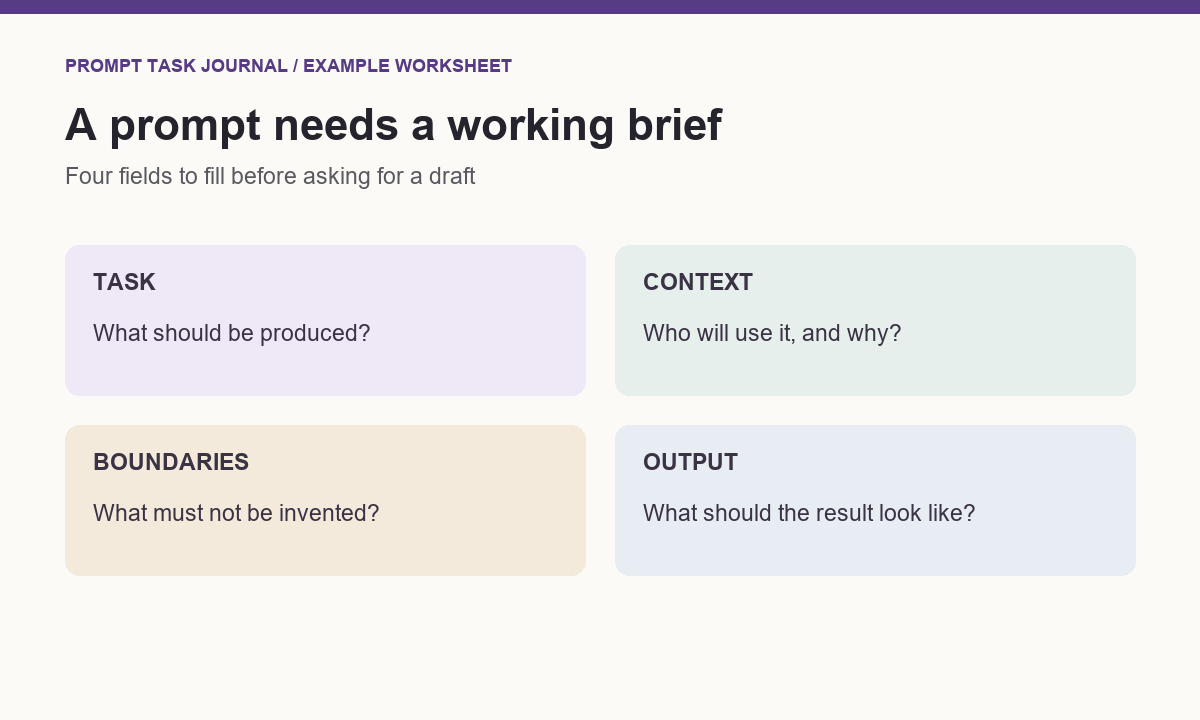
Start with the deliverable
“Help with our launch” leaves the model choosing the task. “Draft a 200-word internal launch update for the support team” sets a usable target. Name the reader and the decision or action the draft should support. A summary for someone approving a release needs different detail from a message for someone answering customer questions.
Provide a small, deliberate context packet
Include the approved facts, the intended audience and any relevant house style. Leave unrelated conversation history out. Label the facts separately from examples so a sample date or company name cannot quietly become a claim about your project. Anthropic’s prompting guidance recommends clear instructions and relevant context; the brief here is our own way to organise those inputs.
Make unknowns a permitted output
Tell the model what to do when the inputs do not contain an answer. Use a visible marker such as [confirmation needed] for a missing release date. This does not guarantee that the model will comply, but it gives you something specific to check. Avoid asking for a confident tone when the underlying facts remain unsettled.
Review against the brief, not the polish
Read the draft with the original fact packet beside it. Check every date, product promise and commitment. Then ask whether the intended reader can act on it. If the output is too long, change the format or priority order rather than repeatedly asking it to “be better”. Save the brief and one corrected example only after that review.
An example to adapt
TASK: Draft an internal launch update, maximum 200 words.
READER: Support colleagues preparing replies to customers.
FACTS: [Paste approved facts only.]
BOUNDARIES: Do not invent dates, availability or commitments. Mark missing details [confirmation needed].
OUTPUT: What changes; what support should do; unresolved questions.
Before drafting, list any missing fact that prevents a usable update.
Illustrative starting point. Adapt it to your inputs, permissions and review process.
Before you use it
- Is the audience explicit?
- Can every factual claim be traced to an input?
- Are unknowns still visible?
- Does the result support a concrete next action?